

§ 6 – Employment income
This covers income from dependent activity paid by an employer under an employment contract, a DPP or DPČ work agreement, an executive service agreement and other arrangements. Each month, your employer calculates a tax advance and deducts it from your pay. It is calculated on your gross salary. You do not claim any expenses.
If your only income is from employment, you can ask your employer for an annual tax reconciliation. Your employer then settles your tax liability to the state, takes account of one-off tax deductions and credits (mortgage interest, pension and life insurance, blood donations, etc.) and refunds any tax overpayment.
If you must file a tax return, i.e. your income outside employment exceeds CZK 6,000, you must arrange this yourself. Employment income is usually evidenced by a certificate of taxable income that your employer gives you in January/February.
§ 7 – Self-employment income
This includes all income from a trade, agricultural production or other business not requiring a trade licence (auditors, doctors… generally professions with professional chambers). It also includes royalties and profit shares of partners in general partnerships or general partners in limited partnerships. You can claim either actual expenses or lump-sum expense deductions against this income. You need to keep records of your income and, where applicable, expenses. Income under this section is generally subject to health and social insurance, which you often already pay through advances during the year. Essentially, health and social insurance are payable only on income under § 6 and 7, i.e. employment and business income.
§ 8 – Dividend income
This is income from capital assets (i.e. financial assets). It typically consists of interest on savings accounts, dividends and interest arising from share ownership. Also watch out for benefits from supplementary pension insurance with a state contribution and for payments from private life insurance that are not insurance claim payments. Shares and the dividends paid on them have become very popular in recent years. Remember that, even if you have not yet sold your shares and therefore have not realised a gain, simply holding them may create tax obligations. No health or social insurance is payable on capital income, so only tax obligations need to be addressed here.
§ 9 – Rental income
Buying property and then letting it has recently become a widespread form of investment. Ongoing rental income further increases the return on these investments. Administratively, rental income is similar to self-employment income in some respects – you can also claim actual expenses or lump-sum expense deductions. Some rules are specific to rentals, however. I often forget that you can also rent out movable property, such as a car. 🙂 It should be noted that no health or social insurance is payable on rent.
§ 10 – Other income
Does your income seem not to fit any of the sections above? Then it may belong here. 🙂 This mainly includes occasional income, income from selling property or securities, prizes from various competitions and lotteries, or gifts received. Also income from inherited royalties. Again, no health or social insurance is payable. Occasional income is also subject to a rule that, if it is not recurring and does not exceed CZK 30,000 per year, you do not even have to file a tax return. Typical examples are one-off letting of property or selling surplus produce from your garden. 🙂
Where can I find this in my tax return?
At the top of page 2 of the tax return:
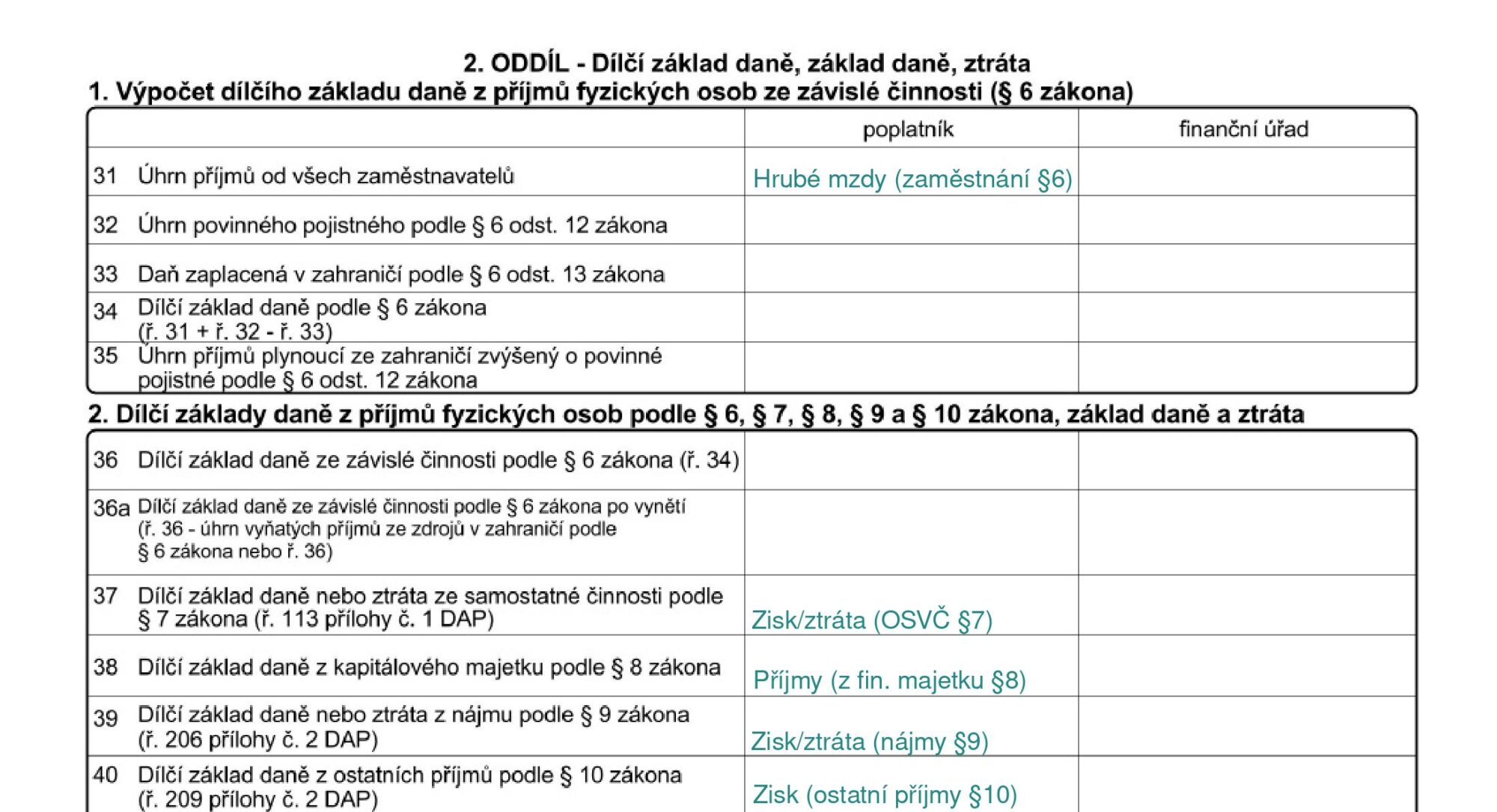
I wrote this article for information. Your accountant may sometimes seem like an alien when throwing around the numbers above. It is a bit of an occupational habit. 🙂 At least now you know what they mean.
If you are unsure, do not hesitate to get in touch and we can look at it together. 🙂