

Types of income and fees
Essentially, there are 3 types of transactions to consider:
- you will receive payments from customers for your deliveries
- you will pay fees to the platform that ‘referred’ customers to you
- you will receive bonuses/incentives from the platform
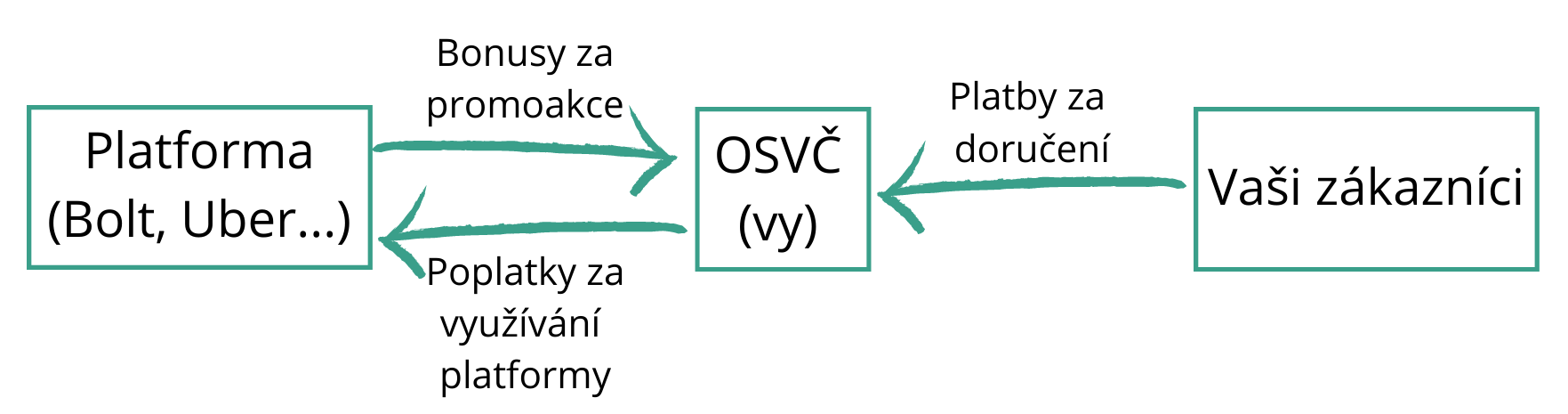
For delivery payments from customers, the situation is straightforward. These are cash or in-app payments for your taxi service or deliveries. The platforms deduct a certain percentage from these amounts as a fee for ‘referring’ the customer to you. In practice, this means an invoice the platform issues to your business identification number. From time to time, platforms offer various promotions to motivate you – for example, ‘complete 3 trips and receive 200 Kč’. These bonuses take the form of self-billing invoices and count as your income. The platform automatically issues the invoices on your behalf – the customer named on them is Bolt, Wolt, etc.
For companies that are based in the Czech Republic (Wolt, Liftago, Dáme Jídlo), the situation is relatively straightforward. Complications arise with platforms that are not based in Czechia. Companies such as Uber or Bolt are based in countries such as the Netherlands or Estonia. We will look more closely at this complication in the next article.
Income tax
At the end of the year, you generate a statement from the platform of all your income from customers for taxi services or food and parcel deliveries. All bonuses for various promotions also count as income. Self-employed people always pay tax only on what reached their bank account or what they received in cash during the calendar year. If you have December earnings that the platform did not send until January, you will tax them in the following year :-).
You can claim expenses against your income in your tax return – there are several ways to do this. Most often, business owners claim what are known as lump-sum expenses, which essentially means you can deduct expenses of 60 % of your annual income without having to substantiate them to the tax office. Lump-sum expenses are often confused with the still relatively new flat-rate tax. This works on the basis of a single monthly amount covering not only tax but also social security and health insurance. Flat-rate tax can benefit many business owners, but you need to be aware of its relatively strict rules. The final option is to claim actual expenses incurred in connection with your business. These expenses may include, among other things, depreciation of the car you use for business. In any case, it is important to work out which expense option benefits you most :-).
In the final article, I will cover value added tax and, above all, everything to watch out for in connection with this type of business :-). If you are unsure, feel free to get in touch and we will look at it together.