

23% personal income tax – who does it affect and when do you pay it?
Who does the 23% tax affect?
The higher tax rate applies only to a smaller proportion of individuals with above-average incomes. These may include, for example:
- Employees with above-average gross wages (above approximately 140 thousand Kč gross per month),
- Business owners with high incomes (above approximately 3 million Kč),
- Taxpayers with higher income from rent, capital assets or property sales…
- Or taxpayers with a combination of the above. ☺️
Two tax rates: 15 % and 23 %
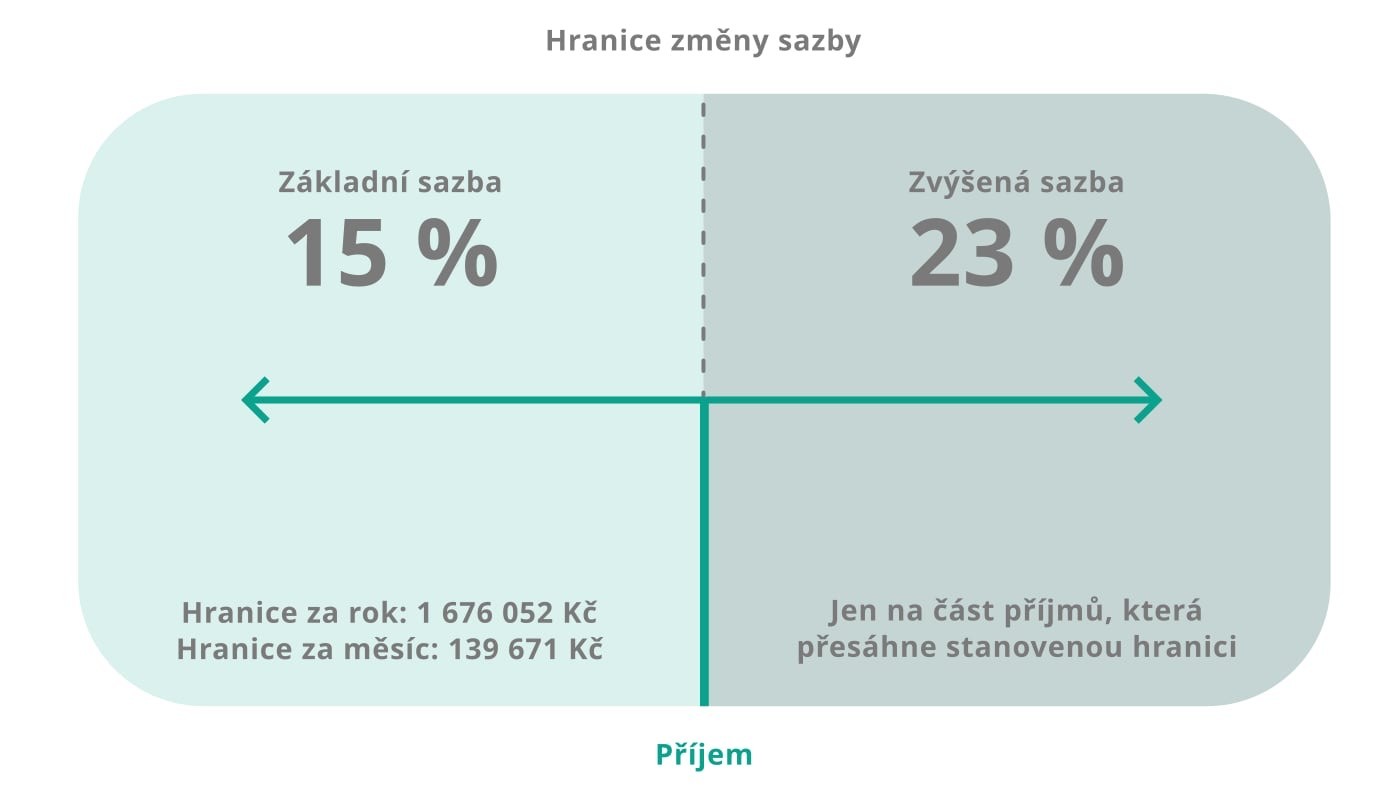
Since 2021, the Czech Republic has applied a two-rate system of personal income taxation:
-
- 15 % – the basic rate paid by most taxpayers.
- 23 % – the higher rate, applied only to the portion of income exceeding the statutory threshold.
- This means that the amount up to the threshold is taxed at 15 %, and the amount above it at 23 %.
For 2025, the threshold is 1 676 052 Kč per year and 139 671 Kč per month. This threshold changes each year according to the average wage in the Czech Republic.
Practical examples
Self-employed people
A business owner has income of 3 100 000 Kč for 2025, meaning their profit after claiming 60% lump-sum expenses is 1 900 000 Kč.
How will it be taxed?
- They pay 15 % tax on 1 676 052 Kč.
- They pay 23 % tax on the difference (1 900 000 − 1 676 052 = 223 948 Kč).
The higher rate therefore applies only to the amount above the threshold. The remainder is taxed at the standard rate.
Employees
If you are an employee and your monthly gross wage exceeds 139 671 Kč, the higher rate applies automatically. Your payroll accountant automatically withholds 23 % each month from the portion of your wages exceeding the threshold.
TIP! Your regular wage may not exceed the threshold, but a bonus in a particular month may take you above it. The payroll department will then indeed deduct higher tax on the amount exceeding the threshold in that month. But there is no need to worry – your entire annual income is considered in the annual tax reconciliation or tax return. Ultimately, the higher tax therefore applies only to the amount exceeding the annual threshold. This means that the entire additional amount withheld in this way may be refunded to you.
Combining income sources
What if you are employed, earn extra income from a business and also rent out a flat? In that case, you will certainly be filing a tax return.
All your income is added together in it – gross employment wages, business profit and rental profit. The process is then the same as above: the amount is divided into the portions below and above the threshold, and the corresponding tax rate is applied to each.
Advance tax payments withheld from your wages during the year, or paid by you to the tax office in connection with your business or rental activity, are deducted from the resulting tax liability.
Are you unsure whether the 23% tax applies to you or how to calculate it correctly in your tax return? Get in touch – we will help you through it step by step, without unnecessary stress. 🌿 You will not get lost in this tax jungle if you choose the right guides. ☺️