

New VAT payer
New statutory requirements apply to your invoices, and you simply must not overlook them. I have prepared a sample invoice, which I think is the clearest illustration.
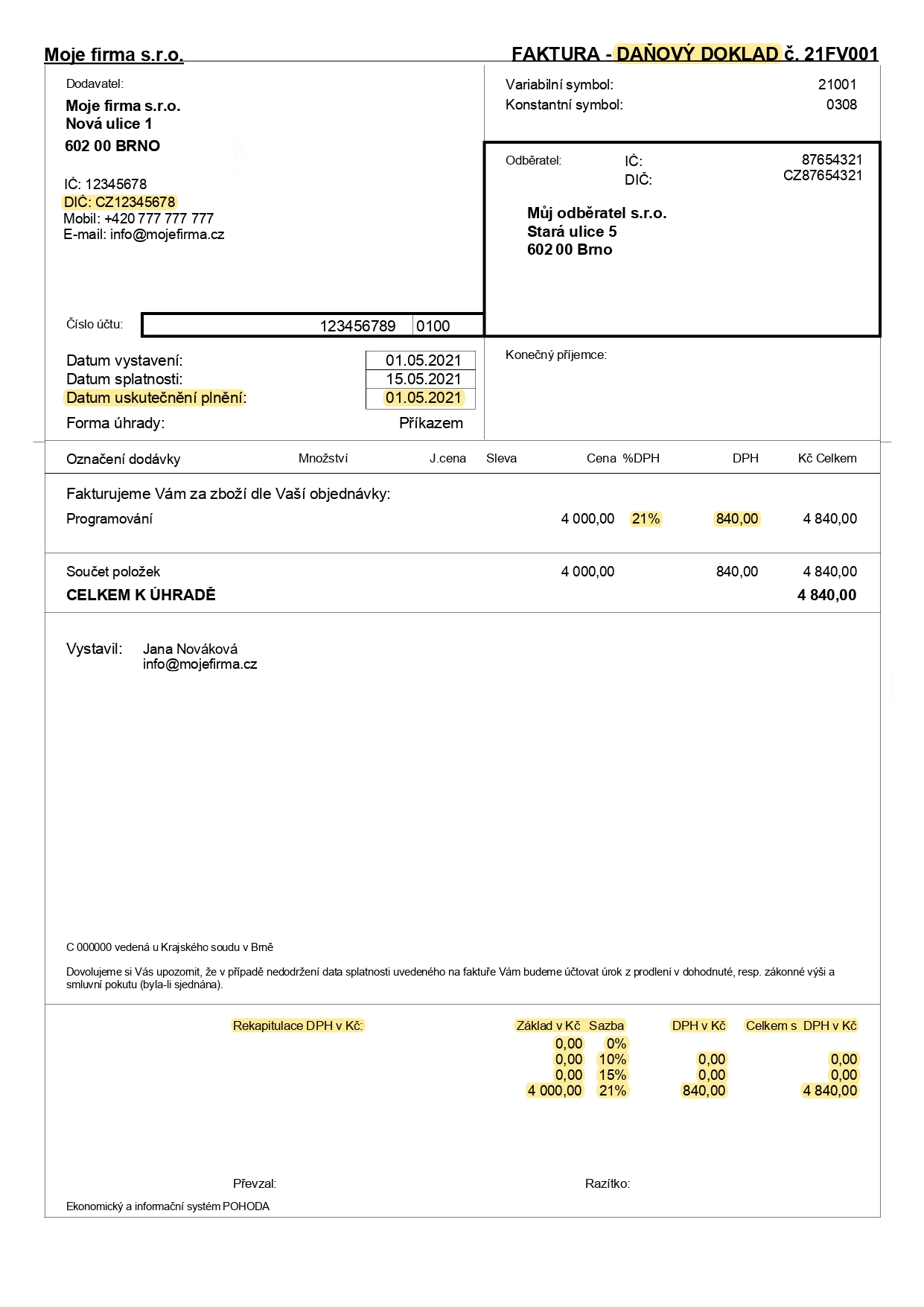
- Invoice – tax document + invoice reference number. Only a VAT payer can issue a tax document, and it must be labelled accordingly. The VAT Act lays down mandatory requirements for tax documents. For amounts up to CZK 10,000, you can issue a simplified tax document (receipt).
- Your VAT number and your customer’s VAT number – there is a European database, VIES, where you can check whether any VAT number is valid. Although you may think it is the customer’s responsibility to give you the correct VAT number, this is not always the case. For example, when invoicing the EU using the reverse charge and charging zero VAT, you can apply this treatment only once you have verified that the other party is a VAT payer who will account for VAT instead of you. In the Czech Republic, a legal entity’s tax identification number is CZ + its company registration number; for individuals, it is CZ + their birth registration number.
- DUZP = date of taxable supply. In other words, the date on which the right to invoice arose
- Goods – the date goods are delivered (the right to dispose of them as owner is transferred)
- Service – the date the service is supplied (if you invoice monthly, the date of taxable supply is always the last day of the month)
- !! Please note !! The date of taxable supply is not the issue date. Once the taxable supply takes place, you have 15 days to issue a tax document. For example, do you provide services on monthly plans? The taxable supply date for April is 30 April, the issue date can be 30 April–15 May, the invoice belongs in the April VAT return, and the return must be submitted by 25 May.
- !! Please note !! If you receive payment before the actual supply of goods or services, the taxable supply date is the date the payment is received. You issue a tax document for the advance payment received.
- Tax base, VAT rate and VAT amount. The best approach is to show VAT for individual items and also in the summary.
Important points
You also need to realise that your prices will change. Although it sounds obvious, many clients get this wrong. Your original price should now equal the tax base. You then simply add VAT on top. From the perspective of a customer who is not a VAT payer or is a private individual, your prices will unfortunately rise; however, remember that you hand all the VAT over to the state—it is not your income.
You must also pay attention to purchase invoices. Your details (company name or first and last name), registered address and VAT number must always appear on purchase invoices. The only exception may be simplified tax documents (receipts) up to CZK 10,000! Above this threshold, you must always obtain a full invoice – tax document from the other party. This is because of the VAT control statement, in which documents over CZK 10,000 are matched. If you claimed VAT on such a receipt for, say, CZK 12,000 and the state could not see that the supplier had declared the VAT against your VAT number, both you and the supplier would receive a request for correction.
The return is then submitted by the 25th day of the month following the month in which you became a VAT payer. If this falls on a weekend or public holiday, the deadline moves to the first working day. Every VAT payer must file monthly for at least the first 2 years. A VAT return and VAT control statement are then submitted monthly, plus an EC Sales List if you invoice the EU. If the company is dormant or no invoices were issued or received in a particular month, you submit only a nil VAT return. A VAT control statement is not submitted if there is nothing to report. An EC Sales List is also submitted only for months in which there is something to report.
New identified person
I discussed when you become an identified person for VAT purposes in relation to services recently. I would mainly stress that an identified person acts in the Czech Republic as a non-VAT payer; a change occurs only for transactions within the EU. This means you do not change or add anything to domestic invoices. You continue to state “Not a VAT payer”. On invoices to other countries, however, you act as an identified person for VAT purposes and add certain further details.
Invoicing the EU
If you issue invoices to the EU, the invoices must include both your and your customer’s VAT numbers. You must verify that the VAT number is valid in the European database. If the VAT number supplied by the customer is invalid, I would consider the appropriate steps individually. Invoicing is without VAT – at a zero rate—and the invoice itself must contain the wording “VAT to be accounted for by the customer”. In this case, you only need to submit an EC Sales List, stating what supplies you invoiced, to whom and for how much. The list is submitted only for months in which there is something to report; no nil list is required.
Receiving invoices for services from the EU
If you became an identified person because you receive invoices, for example, from Google or Facebook for advertising, these purchase invoices must include your billing details and your VAT number. This is the reverse of the previous situation: as the customer, you receive a supply at zero VAT and must account for tax in the Czech Republic, where the service is consumed. In this case, you need to submit a VAT return. Again, a return is submitted only for months in which there is something to report. No nil return is required. On the return, you calculate 21% VAT on the purchase invoices, which you must pay to the Czech treasury.
Sometimes suppliers issue an invoice containing foreign VAT to a Czech identified person. In such cases, you need to explain firmly to the supplier that you are an identified person for VAT purposes, have a valid VAT number and must account for VAT in the Czech Republic, not in another EU country. If they still refuse to correct the invoice, which sometimes happens particularly with large corporations, you are out of luck: unfortunately, you should account for Czech VAT again on the invoice’s tax base. It is a rather unfortunate situation. That is why I urge you to fill in your customer details correctly and check that the invoice you are about to pay is at zero VAT.
You certainly do not need to fear VAT registration; once the whole process is set up, it is not complicated. And if a mistake does slip through, your accountant’s sharp eye is sure to spot it. 🙂