

What are working time records?
We will cover the subject in two articles. In the first, we explain the difference and focus on working time records. In the second, we will look specifically at attendance records, how to maintain them in practice, and why it pays to keep both areas in order.
What is the difference?
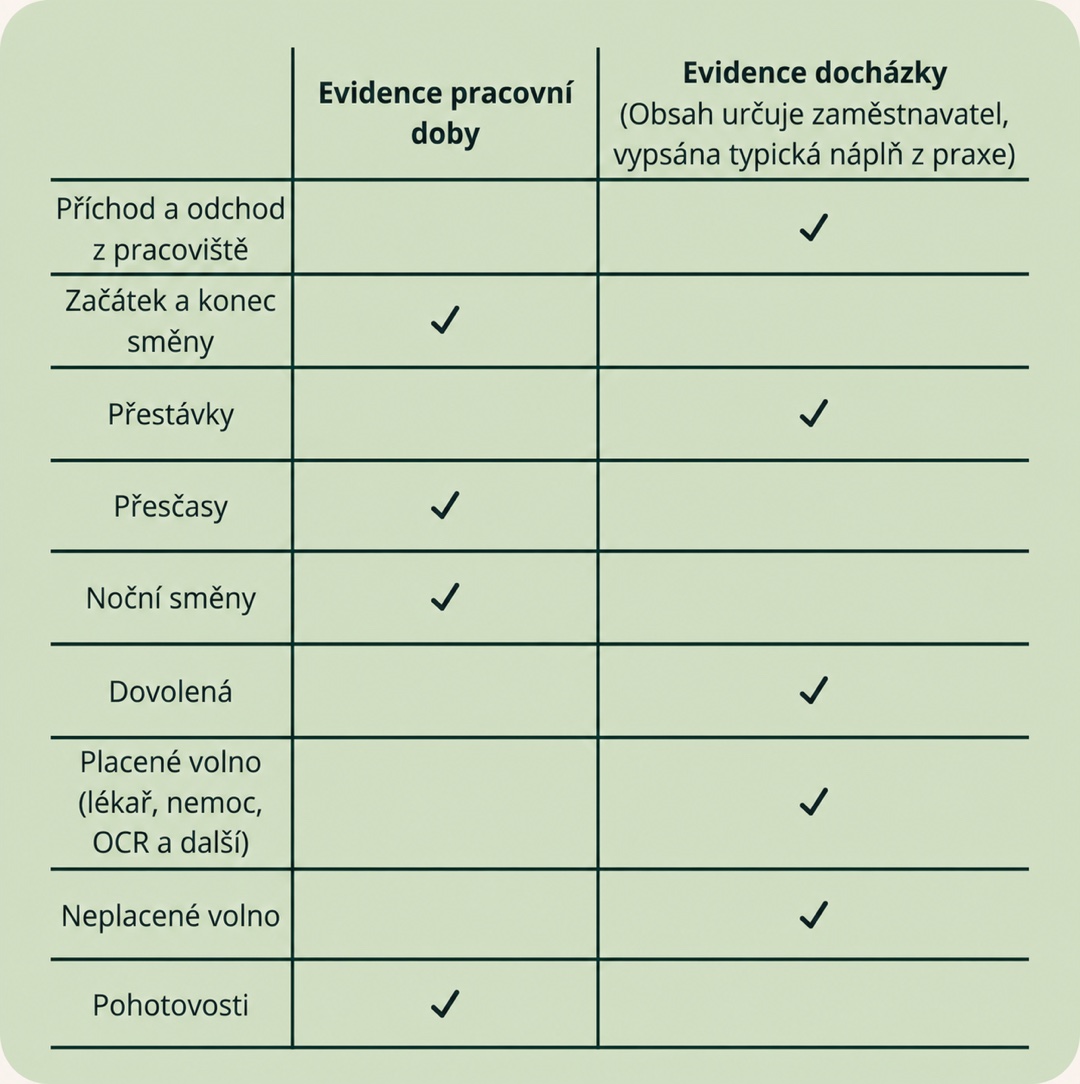
Working time records
Employer obligations
Employer by law must keep working time records for every employee.
The records must be clear, verifiable and open to inspection, both internally and by the Labour Inspectorate.
What must be recorded:
-
- Start and end of shifts (working time schedule)
- Overtime
- Night work (typically between 22:00 and 6:00)
- On-call duty (active and inactive: when the employee must be available and when they work)
- The law does not prescribe one specific format, but emphasises that the data must be verifiable, securely stored, understandable and accurate. For potential court disputes, verifiable evidence is recommended (such as chip-based access cards, employee signatures, etc.).
Good practice
- Choose a format suited to your business — Paper or Excel can work, but electronic systems or specialist software are strongly recommended for larger companies or where there are shifts, night work or on-call duty.
- Ensure transparency — Employees must know how working time is recorded and how errors or deviations from shift schedules are handled. by law they must also be allowed to inspect the records.
- Archiving — Working time records should be retained for up to 45 years, ideally securely, electronically and with a backup.
Possible penalties for breaches
Financial penalties:
- Up to CZK 400,000 for failing to keep working time records
- Up to CZK 1,000,000 for failing to comply with working time scheduling
In 2024, the State Labour Inspection Office completed 2,459 working time inspections and imposed dozens of fines.
Other consequences for employers:
- A corrective order from the Labour Inspectorate requiring proper records
- Inability to substantiate wages and supplements paid
- Court disputes with employees over unpaid overtime
- Damage to the company’s reputation, affecting employees and business partners
How can you avoid problems?
- Keep accurate, ongoing working time records, including overtime, shifts and breaks
- Respect statutory limits on working time and rest
- Regularly check wage and supplement calculations
Summary
Working time records are not something to take lightly: they are simply an obligation.
Get them right and everyone benefits: your payroll accountant can relax, employees know where they stand, and an inspection brings no unpleasant surprises. 🌿